
Traffic Drop Recovery Services to Find the Cause and Fix It
When organic traffic falls, the first job is to find out when it fell and why. Our traffic drop recovery services use Google Search Console, Ahrefs, and other available data to investigate your whole site. We identify likely causes, prioritize fixes, and monitor changes as new data arrives.
What Our Traffic Drop Recovery Services Investigate
Six checks narrow a drop down to its real cause.
Drop Timeline Analysis
We find the exact date the decline started. Then we match it against site changes, Google updates, and Search Console messages from that period.
Page and Query Comparison
We compare clicks, impressions, click-through rate, and average position before and after the drop. We split them by page group, query, device, and country.
Technical and Indexing Review
We check crawling, indexing, redirects, and canonicals for changes that cut visibility. A sudden drop can mean a technical issue, but we confirm it first.
Content and Intent Review
Pages that lost traffic are reviewed for search intent, depth, and freshness. We flag thin, outdated, or duplicated content that may need work.
Link and Competitor Review
We check lost or risky backlinks in Ahrefs. We also look at which competitors gained visibility since the drop, and what changed on their pages.
Tracking and Manual Action Checks
Before blaming rankings, we rule out broken analytics tags and reporting glitches. We also review Search Console for security issues or manual action messages.
Reading the Pattern of a Drop
Based on Google’s guidance, the shape of a drop gives the first clue to its cause.
| What you see | Possible cause | What we check first |
|---|---|---|
| A sudden, site-wide fall | A site-wide technical issue or a manual action | Page indexing and Manual actions reports |
| A gradual decline | Content relevance changes, competitors gaining visibility, technical issues, algorithm changes, or reduced search demand | Drop dates against update windows, page groups, and competitor changes |
| Losses in a few sections only | Changes to the content, links, or templates of those sections | Affected page groups before and after the drop |
| Dips at the same time each year | Seasonality | The same period in previous years |
| Analytics falls but Search Console is steady | A tracking or reporting problem | Analytics tags against Search Console data |
A pattern is only a clue. We confirm the cause with data from your whole site. If you also want a wider health check, a site-wide SEO audit covers it.
From Drop Date to Fix Plan
Each project moves from evidence to fixes to monitoring.
- Share the history: Tell us when traffic fell, what changed on the site, and share Search Console and analytics access.
- Find when and why: We analyze the whole site and match the drop timeline against the evidence.
- Fix in stages: We apply fixes in priority order, or guide your developer, so each change can be tracked. Pages that need rewriting can go to our SEO content writing team.
- Monitor recovery: We compare performance with your pre-drop baseline in Search Console.

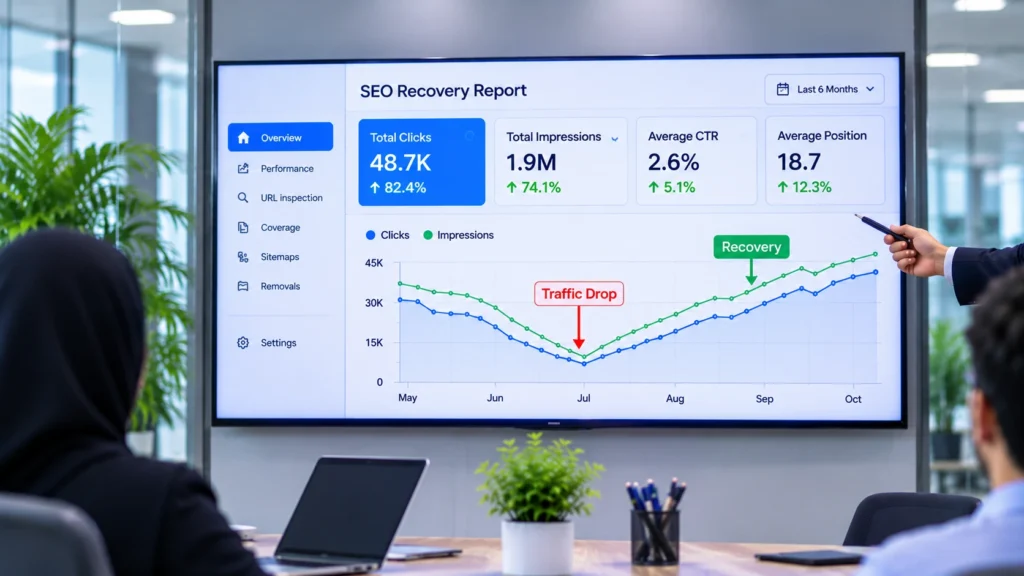
Your Recovery Documents
Our SEO recovery service produces written findings, so you can see the reasoning behind each fix.
- Drop timeline: the date range of the decline, matched against site changes and known events.
- Cause report: the evidence for each likely cause, and the causes we ruled out.
- Page-level loss list: the pages and queries that lost the most traffic, ranked by impact.
- Staged fix plan: prioritized fixes in order, with what to watch after each one.
- Recovery tracking: performance against the pre-drop baseline, updated as fixes go live.
Common Mistake: Changing many things at once after a drop. When everything changes together, no one can tell what helped and what caused more harm. Find the cause first, then fix in stages.
Traffic Drop Recovery Services FAQs
Start With the Date of the Drop
A drop in traffic is easier to fix once its cause is known. Traffic drop recovery services start by finding that cause with evidence from your whole site.
Tell us when your traffic started falling and what changed around that time. We will review your data and explain what we find.